
Travel should be about excitement, adventure, and making memories—not worrying about how you’ll get from check-in to your gate.
For travelers who use wheelchair assistance, navigating a large airport can sometimes feel like one of the most challenging parts of the journey. Long distances, crowded terminals, changing gates, and tight connection times can add stress before a vacation even begins.
The good news? Technology is helping make travel more accessible than ever before.
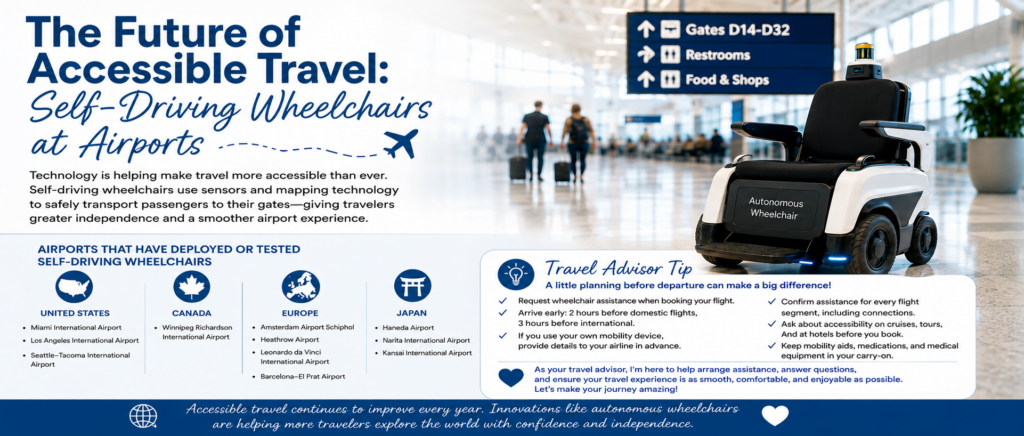
One of the most exciting innovations appearing in airports around the world is the introduction of autonomous, or self-driving, wheelchairs. These advanced mobility devices use sensors, cameras, and mapping technology to safely transport passengers through airport terminals without requiring an employee to push them.
For many travelers, this means greater independence, increased comfort, and more control over their airport experience.
A Glimpse Into the Future
Self-driving wheelchairs are designed to help passengers move independently through busy airport environments. Using sophisticated navigation systems, they can guide travelers to gates, restrooms, restaurants, shops, and other airport services while avoiding obstacles along the way.
While the technology is still being expanded, several airports around the world have already deployed or tested autonomous wheelchair programs.
As of June 2026, these are the airports that offer these wheelchairs.
United States
- Miami International Airport
- Los Angeles International Airport
- Seattle-Tacoma International Airport
Canada
- Winnipeg Richardson International Airport
Europe
- Amsterdam Airport Schiphol
- Heathrow Airport
- Leonardo da Vinci International Airport (Rome)
- Barcelona-El Prat Airport
Japan
- Haneda Airport
- Narita International Airport
- Kansai International Airport
As this technology continues to develop, travelers can expect even more airports to adopt innovative mobility solutions that make air travel easier and more accessible.
How Do Self-Driving Airport Wheelchairs Work?
One of the most impressive aspects of autonomous wheelchairs is how simple they are for travelers to use.
Passengers can often request an autonomous wheelchair on the day of travel or arrange wheelchair assistance when booking their flights. Upon arrival at the airport, travelers simply speak with an airline or airport representative, who can help determine whether an autonomous wheelchair is available and appropriate for their journey.
For passengers making connections, airport staff may escort them to a designated assistance area before helping them transition to an autonomous wheelchair for the remainder of their trip through the terminal.
Once seated, travelers can store a carry-on bag in a compartment located behind the chair. The wheelchair’s touchscreen allows passengers to select their preferred language and choose their departure gate. From there, the chair takes over and safely navigates through the airport.
Using advanced sensors, cameras, and mapping technology, the wheelchair follows a pre-programmed route designed to be both safe and efficient. The system continuously monitors its surroundings, detecting other travelers, airport equipment, and obstacles along the way. The chair emits gentle audible alerts to make nearby passengers aware of its presence while maneuvering through busy terminal areas.
While the wheelchair operates independently, travelers are never completely on their own. Airport representatives monitor the chairs and passengers throughout the journey to ensure everything runs smoothly.
When the wheelchair arrives at the departure gate, passengers gather their belongings and board the aircraft using the jet bridge. The autonomous wheelchair remains at the gate and automatically returns to its designated dispatch area, ready to assist the next traveler.
For many passengers, this technology offers something truly valuable: greater independence, reduced waiting times, and a more comfortable airport experience from check-in to boarding.
Traditional Wheelchair Assistance Still Plays an Important Role
While self-driving wheelchairs are an exciting glimpse into the future, traditional wheelchair assistance remains the primary service available at most airports worldwide.
When booking flights, it’s important to request the correct level of assistance through your airline. Understanding the different wheelchair assistance codes can help ensure you receive the support you need throughout your journey.
WCHR | Wheelchair Ramp
Passengers can walk short distances and climb stairs but require wheelchair assistance throughout the airport.
WCHS | Wheelchair Steps
Passengers cannot walk long distances or use stairs but can transfer independently to their aircraft seat.
WCHC | Wheelchair Cabin Seat
Passengers require full assistance from check-in through boarding and transfer to their aircraft seat.
Selecting the correct assistance level helps airport and airline staff provide the support that best meets your needs.
Why Planning Ahead Matters
As someone who frequently travels with family members who use wheelchair assistance, I know firsthand how valuable these services can be.
A little planning before departure can dramatically reduce stress and help create a smoother, more enjoyable travel experience.
Requesting assistance in advance allows airlines and airports to prepare for your arrival and helps ensure the appropriate accommodations are in place before you arrive at the airport.
Travel Advisor Tip
Don’t wait until the last minute to request assistance.
If you or a traveling companion will need wheelchair assistance, be sure to request it when you book your flights. While airlines can often add assistance later, making the request early helps ensure the service is properly noted in your reservation.
A Few Additional Tips:
✈️ Arrive at the airport at least 2 hours before domestic flights and 3 hours before international flights.
✈️ If you use your own wheelchair or mobility device, notify the airline in advance and provide details about the type, size, and battery (if applicable).
✈️ For connecting flights, verify that wheelchair assistance is noted for every segment of your journey.
✈️ If you’re traveling on a cruise, river cruise, guided tour, or staying at a hotel, ask about accessibility options before booking. Not all destinations, ships, hotels, or excursion providers offer the same level of accessibility.
✈️ Keep mobility aids, medications, and essential medical equipment in your carry-on luggage whenever possible.
Accessible Travel Is Improving Every Year
From more inclusive cruise ships and hotels to airport innovations like autonomous wheelchairs, the travel industry continues to make meaningful strides toward helping everyone explore the world with greater confidence and independence.
Travel should be accessible to everyone, regardless of mobility challenges.
The future of travel isn’t just about discovering new destinations—it’s about ensuring those destinations are accessible to all.
As your travel advisor, we are always happy to help arrange wheelchair assistance, answer accessibility questions, and work with travel companies to make your journey as smooth, comfortable, and enjoyable as possible.
A little preparation before departure can go a long way toward creating a stress-free travel experience and allowing you to focus on what matters most—making incredible memories.