

Travel is one of life’s greatest joys, but over the years, we’ve learned that many travel headaches aren’t caused by bad luck—they’re caused by simple mistakes that are completely avoidable.
One of the most rewarding parts of helping clients plan their vacations is sharing the little things that many travelers don’t discover until it’s too late. I love hearing comments like, “I’m so glad you mentioned that,” “I never would have thought of that,” or “Why has no one ever told me this before?” Those simple tips can make the difference between a stressful trip and a smooth, memorable vacation.
Here are some of the biggest travel mistakes we see—and how you can avoid them.

Many travelers believe waiting will lead to a better price.
While last-minute deals do exist occasionally, they’re becoming much less common. More often, waiting means:
- Higher prices
- Fewer flight options
- Limited hotel choices
- Less cabin availability on cruises
- Missing out on promotions
Planning early gives you the best selection and often the best overall value.
Travel Tip: If you know where you’d like to go, start planning 8–24 months in advance, especially for cruises and popular international destinations. Booking early gives you the best selection of itineraries, sailing dates, staterooms, hotels, allowing you to choose the options that best fit your travel style—not just what’s left.
One of the advantages of booking early is that many cruise lines and tour companies allow your reservation to be repriced if a lower fare becomes available before final payment. However, it’s important to understand that repricing usually means giving up the promotions that were included with your original booking and replacing them with whatever promotions are being offered at that time. Depending on the value of your original perks—such as onboard credit, cabin upgrades, prepaid gratuities, airfare promotions, or reduced deposits—it may not always be the better deal.
Before making any changes, reach out to your travel advisor. We can compare your original booking with the current offer and help determine which option provides the greatest overall value—not just the lowest price.r
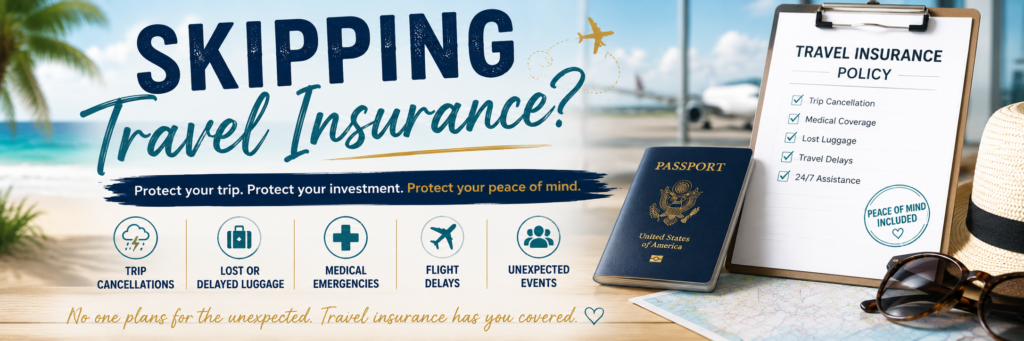
No one plans for:
- Illness
- Flight cancellations
- Lost luggage
- Severe weather
- Family emergencies
But these situations happen every single day.
One of the most common things I hear is:
“Travel insurance is so expensive.”
My response is usually:
“Travel insurance seems expensive…until you need it.”
After helping hundreds of travelers plan vacations over the years, I can honestly say that I’ve seen travel insurance save my clients thousands of dollars.
We’ve had clients who had to cancel a dream vacation just days before departure because of an unexpected illness, a family emergency, or another covered event. Because they had purchased travel insurance, they were able to recover the cost of their trip according to the terms of their policy instead of losing the money they had invested.
I’ve also had clients become sick or injured while traveling. Whether it was needing emergency medical care overseas, requiring hospitalization, or having to interrupt their vacation and return home early, travel insurance provided assistance when they needed it most.
Those are situations no one expects—but they happen more often than many travelers realize.
What About Medical Care on a Cruise?
This is something many first-time cruisers don’t think about.
Cruise ships have licensed doctors and medical facilities onboard, but medical treatment is not included in your cruise fare.
Even a simple visit to the ship’s medical center can cost several hundred dollars, and more serious treatment can quickly climb into the thousands of dollars. If a passenger needs emergency evacuation by helicopter or air ambulance, the cost can reach tens of thousands of dollars, depending on where the ship is located.
Many U.S. health insurance plans—including Medicare—provide little or no coverage outside the United States or onboard a cruise ship. That’s why travel medical coverage can be so valuable.
It’s More Than Just Reimbursing Your Trip
Many travelers think travel insurance only protects the money they’ve spent on their vacation.
In reality, many policies can also provide benefits such as:
- Trip cancellation and interruption coverage
- Emergency medical treatment
- Emergency medical evacuation
- Lost, stolen, or delayed baggage
- Flight delays and missed connections
- Travel assistance services available 24/7
The exact benefits vary by policy, which is why it’s important to understand your coverage before you travel.
We hope none of our clients ever have to use their travel insurance. But when something unexpected happens, we’re incredibly grateful they chose to protect their vacation.
We’ve seen firsthand how travel insurance has turned what could have been a devastating financial loss into a manageable situation. It can’t prevent unexpected events from happening, but it can provide financial protection and valuable support when they do.
Travel insurance isn’t just about protecting your vacation. It’s about protecting your investment, your health, and your peace of mind.
One of the best pieces of advice we can give any traveler is this: Travel insurance feels expensive until you need it. Once you do, it’s often one of the best purchases you made for your trip.
As your travel advisor, we’ll always take the time to explain your travel insurance options so you can make an informed decision that’s right for you and your vacation. Our goal is always for you to travel with confidence, knowing you’re prepared for the unexpected.

This is one of the biggest travel mistakes we see.
Even the most reliable airlines experience delays, weather disruptions, mechanical issues, and occasional cancellations. While most travelers arrive without any problems, it only takes one unexpected delay to create a stressful—and sometimes very expensive—start to your vacation.
If you’re joining a river cruise, ocean cruise, or guided tour, your vacation begins on a specific date and time. Unlike a hotel stay, your ship or tour simply can’t wait for delayed flights. Missing embarkation or the first day of your tour can result in unexpected transportation costs, missed experiences, and unnecessary stress.
Whenever possible, we recommend arriving at least one day before your cruise or tour begins. For destinations that involve long-haul or international flights, multiple connections, or significant time zone changes, arriving two or even three days early can make an even bigger difference.
Not only does arriving early provide a cushion against travel delays, but it also allows your body time to adjust to the new time zone before your vacation officially begins. Instead of stepping off a long flight and immediately rushing to board a ship or join a tour, you’ll have the opportunity to rest, recharge, and ease into your travels.
Another benefit many travelers don’t realize is that your embarkation city is often a destination in its own right. Whether you’re boarding a river cruise in Amsterdam, Budapest, Paris, or Basel, or an ocean cruise from cities like Barcelona, Rome (Civitavecchia), Vancouver, Seattle, or Athens, these places offer incredible history, architecture, restaurants, and local culture.
Once you board your ship, you’ll likely be focused on your itinerary, and in many cases, you won’t have the opportunity to fully experience the embarkation city. Arriving early gives you time to explore the local sights, enjoy a wonderful meal, stroll through historic neighborhoods, and truly begin your vacation before embarkation.
Travel should never feel rushed.
By arriving a day—or even a few days—early, you’ll start your vacation at a slower, more enjoyable pace, giving yourself time to settle in, adjust to your surroundings, and begin making memories from the moment you arrive.
Travel Tip: The vacation doesn’t begin when you board the ship—it begins the moment you arrive at your destination. Give yourself the gift of time, and you’ll enjoy a smoother, more relaxing start to your journey.
Many travelers assume their passport only needs to be valid until they return home.
In reality, many countries require your passport to be valid for at least six months beyond your travel dates. Failing to meet those requirements could result in being denied boarding or refused entry into your destination.
We’ve seen travelers discover this just weeks before departure, creating unnecessary stress and, in some cases, delaying or changing their travel plans.
One of the easiest ways to avoid this is to provide your travel advisor with your passport information when you book your trip. We’ll review the expiration date and let you know if it needs to be renewed long before you travel.
A quick passport check today can save you from a last-minute scramble tomorrow—and help ensure your vacation begins exactly as planned.
Travel Tip: As soon as you book your vacation, take a minute to check your passport. Better yet, send your passport information to your travel advisor so we can verify everything for you. It’s one less thing for you to worry about and one more way we help make your travels as smooth and stress-free as possible.
Bonus Travel Tip: Take both a digital copy and a paper copy of your passport and keep them separate from the original. If your passport is ever lost or stolen, having copies of it can make the replacement process much quicker and easier at the nearest embassy or consulate. It’s a simple step that can save you valuable time and reduce stress while traveling.

It’s easy to be drawn to the lowest airfare, but the cheapest ticket isn’t always the best value.
Many airlines now offer Basic Economy fares that can look like a great deal at first glance. However, these fares often come with restrictions that can make your travel day more stressful—and sometimes end up costing more than you expected.
Depending on the airline, a Basic Economy ticket may include limitations such as:
- No advance seat selection
- Checked baggage fees or reduced baggage allowance
- No changes or cancellations
- Limited or no frequent flyer mileage earnings
- Lower boarding priority
- Restrictions on upgrades
A fare that’s only $50–$100 less can quickly become more expensive once you add baggage fees, pay for seat assignments, or need to make a change to your itinerary.
More importantly, the least expensive ticket may not offer the best schedule. A lower fare could mean longer layovers, multiple connections, or less convenient departure and arrival times—all of which can add unnecessary stress to your vacation.
Think Value, Not Just Price
When comparing flights, it’s important to look beyond the price tag and consider what’s included.
Ask yourself:
- Is my seat included?
- Will I need to pay for checked bags?
- Can I make changes if my plans change?
- Are the flight times and connections convenient?
- Am I earning frequent flyer miles?
- What will my total cost be after adding any extras?
Sometimes spending a little more upfront provides significantly more flexibility, convenience, and peace of mind.
Travel Tip: One of the ways we help our clients is by looking at the complete travel experience—not just the airfare. We compare flight schedules, connection times, baggage policies, fare rules, and overall value to help you choose the option that best fits your vacation and budget.
Our goal isn’t simply to find the lowest price—it’s to help you arrive at your destination comfortably, confidently, and ready to enjoy your vacation from the moment your journey begins.

Pack Smarter, Not Heavier
One of the comments we hear most after travelers return home is:
“I packed way more than I needed!”
Packing lighter makes every part of your trip easier—from navigating airports and train stations to moving between hotels and exploring your destination.
A good rule of thumb is to lay out everything you think you’ll need, then remove about a third of it. You’ll probably never miss those items.
Even better, leave a little extra room in your suitcase for souvenirs, local treasures, or that special item you discover during your travels. You’ll be glad you have the space when it’s time to head home.
Remember, if you forget something, chances are you can purchase it at your destination. Most hotels and cruise ships also offer laundry services (for a fee), making it easy to freshen up your wardrobe during longer trips instead of packing for every possible occasion.
Another great tip is to pack in layers. Lightweight clothing that can be mixed and matched gives you more outfit options while taking up less space. A light sweater or jacket can easily be added or removed as temperatures change.
Travel Tip: Pack for the trip you’re taking—not for every “just in case” scenario. A lighter suitcase means less stress, greater flexibility, and more room to bring home the memories you’ll treasure long after your vacation ends.”I packed way more than I needed.”
Heavy luggage makes airports, train stations, hotels, and sightseeing much more difficult.
Packing lighter gives you more flexibility and less to worry about.
A simple trick? Lay out everything you think you’ll need, then remove about a third of it. You’ll probably never miss those items.
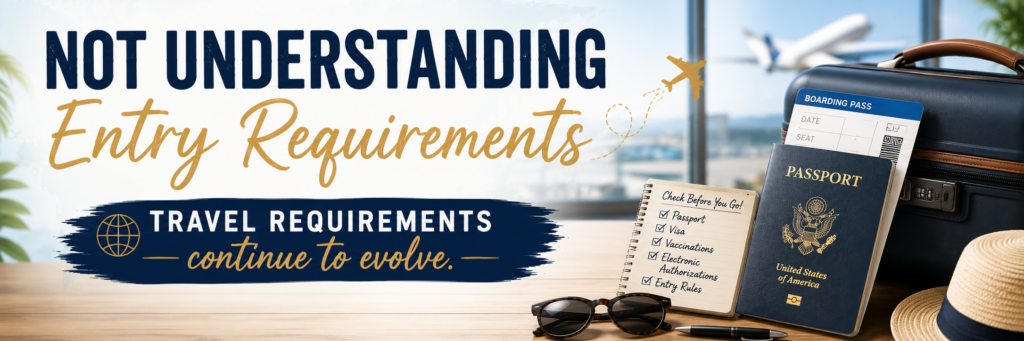
International travel requirements are constantly changing, and what was required for your last trip may not be the same for your next one.
Depending on your destination, you may need:
- Electronic Travel Authorizations (ETAs)
- Tourist or entry visas
- Digital arrival or customs forms
- A passport that’s valid for at least six months beyond your travel dates
- Destination-specific entry requirements
Missing even one of these requirements could result in delayed boarding, denied entry, or unnecessary stress before your vacation even begins.
The good news is that most of these requirements are easy to take care of—as long as you know about them in advance.
Travel Tip: One of the many benefits of working with a travel advisor is that we help keep you informed about the latest entry requirements for your destination. We’ll let you know what documents may be needed before you travel, so you can focus on the excitement of your upcoming vacation instead of worrying about paperwork.
A few minutes of preparation before you leave can help ensure a smooth departure and a stress-free start to your adventure.

One of the best ways to make your vacation even more memorable is to spend a little time getting to know your destination before you arrive.
Every country—and often every region—has its own traditions, customs, transportation systems, tipping practices, and local etiquette. Understanding these differences ahead of time helps you feel more confident and allows you to experience your destination in a more meaningful way.
Take a few minutes to learn:
- Local customs and cultural traditions
- Tipping expectations
- Public transportation options
- Currency and common payment methods
- Popular local foods to try
- Safety tips and local etiquette
- Hidden gems beyond the typical tourist attractions
One of our favorite travel tips is to learn a few simple words or phrases in the local language. You don’t need to be fluent—just knowing how to say “Good morning,” “Please,” “Thank you,” or “Cheers!” shows respect for the local culture and often brings a smile to the faces of the people you meet.
Don’t be afraid to wander beyond the most popular attractions. Some of the most memorable travel experiences happen when you discover a neighborhood café, a family-owned restaurant, a scenic overlook, or a local market that isn’t listed in every guidebook. These hidden gems often become the stories you’ll remember long after your vacation ends.
Travel Tip: The more you know before you arrive, the more comfortable and confident you’ll feel exploring your destination. A little research can transform a great vacation into an unforgettable one, helping you connect with the local culture, discover places many visitors miss, and create memories that go far beyond checking famous landmarks off a list.

While many credit card companies no longer require travel notifications, some banks and credit card issuers still monitor unusual spending patterns. If your card is suddenly used in another state or country, your bank may temporarily decline the transaction as a fraud prevention measure.
Before you leave, take a few minutes to:
- Check whether your bank recommends a travel notification.
- Confirm that your debit and credit cards will work in the countries you’ll be visiting.
- Understand any foreign transaction fees your cards may charge.
It’s also a good idea to carry at least two different payment methods, such as two credit cards or a credit card and a debit card. If one card is lost, stolen, damaged, or unexpectedly declined, you’ll still have access to your money.
Another smart travel habit is to make copies of your credit and debit cards—both the front and back—and keep them separate from your wallet or save secure digital copies in a password-protected app or encrypted cloud storage. If a card is lost or stolen, you’ll have the card numbers and the bank’s customer service phone numbers readily available, making it much easier to report the loss and request a replacement.
Travel Tip: Don’t keep all of your payment methods in one place. Leave one card securely locked in your room safe or in a separate bag while carrying another with you. If your wallet goes missing, you’ll still have a backup and can continue enjoying your vacation with far less stress.
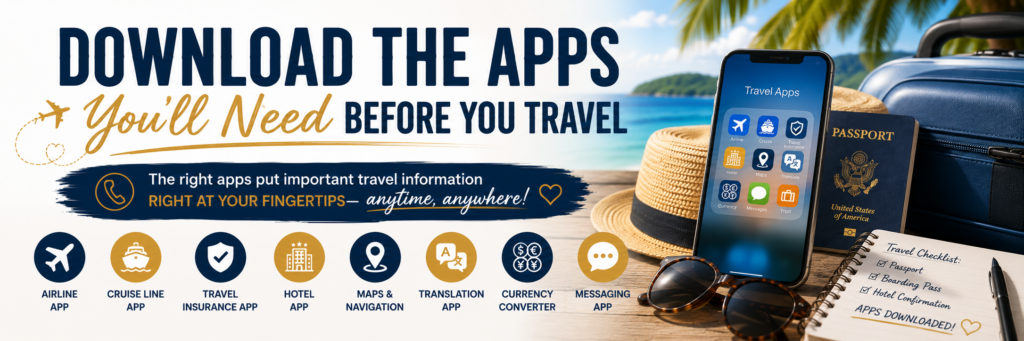
One of the easiest ways to make your vacation smoother is to download your travel apps before you leave home.
Today’s travel apps put important information right at your fingertips and can save you valuable time if your plans change.
Before your trip, consider downloading:
- Airline App – Boarding passes, gate changes, flight notifications, baggage tracking, and easy rebooking.
- Cruise Line App – Online check-in, daily schedules, dining reservations, shore excursions, deck maps, and onboard messaging.
- Travel Insurance App – Policy information, emergency assistance numbers, medical provider search, and claims.
- Hotel App – Reservations, mobile check-in, room information, and direct communication with the property.
- Google Maps or Offline Maps – Download maps before you leave so you can navigate even without internet service.
- Translation App – Translate menus, signs, and conversations with ease.
- Currency Converter – Quickly see exchange rates while shopping or dining.
- Messaging Apps (WhatsApp, Messenger, etc.) – Stay connected with family and friends while traveling internationally.
Travel Tip: Download and log into your apps before you leave home while you have reliable Wi-Fi. Save your passwords, enable notifications, and download any offline maps or boarding passes in advance. Taking just a few minutes to prepare can save you a lot of time and stress once your vacation begins.
We would also include one more app that many travelers overlook:
Government Travel App (if applicable) – For example, the U.S. Department of State’s Smart Traveler Enrollment Program (STEP) allows U.S. citizens traveling abroad to receive safety alerts and makes it easier for the U.S. Embassy to contact or assist them in an emergency. This is especially valuable for international travelers.
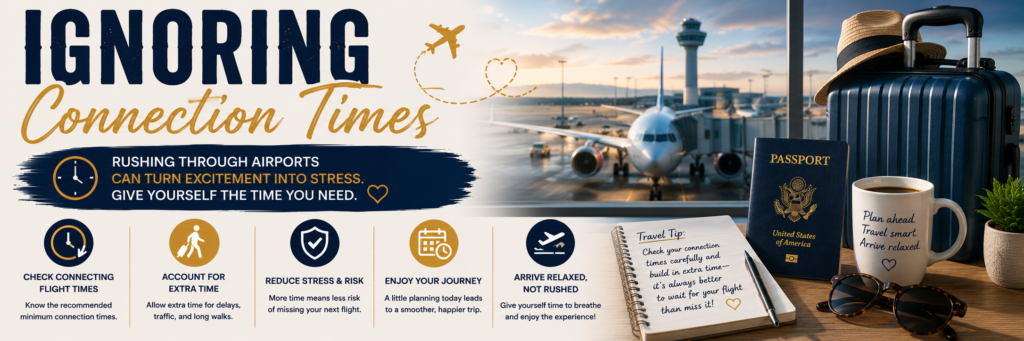
A 35-minute connection might look fine on paper…
Until your first flight is delayed.
When booking flights, try to allow yourself a little extra time between connections—especially if you’re traveling internationally, changing terminals, or flying through a large airport. A slightly longer layover can make the difference between a relaxed travel day and a stressful sprint through the airport.
Travel Tip: Give yourself enough time to account for delays, security, and terminal transfers. It’s always better to spend a little extra time waiting for your next flight than to miss it altogether.

Forgetting your prescription medications can quickly turn a dream vacation into a stressful situation. Replacing medications while traveling—especially internationally—can be difficult, expensive, and, in some cases, impossible without a prescription from a local doctor.
Always pack your medications in your carry-on bag, never in your checked luggage. If your suitcase is delayed, lost, or arrives after you do, you’ll still have the medications you need.
It’s also a good idea to bring enough medication for a few extra days in case your return home is delayed due to weather, flight cancellations, or other unexpected travel disruptions.
Travel Tip: Keep your medications in their original labeled prescription containers and carry a copy of your prescriptions or a list of your medications. This can be extremely helpful if you need medical care or have to replace a prescription while you’re away.

Many travelers assume their cell phone will work the same way it does at home—but that’s not always the case. International roaming charges can be surprisingly expensive, and some phone plans may not include service in the countries you’re visiting.
Before you travel, check with your wireless provider to understand your international coverage and any potential fees. If you’re traveling abroad, consider adding an international plan or using an eSIM if your phone supports it. This can often save you money while keeping you connected.
It’s also a good idea to download offline maps before you leave. Apps like Google Maps allow you to save maps in advance, so you can navigate even without cellular service or Wi-Fi.
Travel Tip: Don’t wait until you land to figure out your phone service. A few minutes of preparation before your trip can help you avoid unexpected charges and stay connected wherever your travels take you.

One of the easiest ways to reduce travel stress is to keep all of your important travel documents in one organized, easy-to-access place.
Before you leave, gather everything you’ll need, including:
- Passport
- Boarding passes
- Hotel confirmations
- Cruise or tour documents
- Travel insurance information
- Emergency contact information
- Transportation confirmations (flights, trains, rental cars, transfers)
- Attraction and excursion tickets
Keeping everything together means you’re not searching through emails or multiple apps while standing in an airport line or checking into your hotel.
For added peace of mind, save digital copies of your important documents on your phone and email copies to yourself. If your phone is lost or damaged, you’ll still be able to access them from another device.
Travel Tip: If you’ve booked excursions, attraction tickets, train tickets, or other reservations, consider printing paper copies before you leave. It’s also a good idea to make a copy for each traveler in your group, so everyone has their own set of important documents. If someone’s phone battery dies or you get separated, everyone will still have the information they need to continue enjoying the trip.

A quick weather check a few days before you leave can make a big difference in how you pack—and how much you pack.
We’ve seen travelers arrive in:
- Europe during a heat wave with only sweaters.
- Alaska without layers, expecting it to be cold all day.
- The Caribbean during the rainy season without a lightweight rain jacket or umbrella.
Weather can vary dramatically depending on the destination, the season, and even the time of day.
Checking the forecast a few days before departure helps you pack smarter, avoid bringing unnecessary items, and make room for the things you’ll actually use. Packing for the expected conditions can save suitcase space, reduce baggage weight, and make your trip much more comfortable.
Travel Tip: Check the weather about 3–5 days before departure, then pack versatile layers instead of “just in case” outfits. You’ll be better prepared, avoid overpacking, and still have everything you need to enjoy your vacation—rain or shine.

This may be the biggest travel mistake of all.
It’s tempting to fill every day with sightseeing, excursions, and must-see attractions. After all, you’ve traveled a long way, and you don’t want to miss a thing.
But some of the most memorable moments aren’t found on an itinerary.
Leave yourself time to:
- Stroll down a street that catches your eye.
- Enjoy a coffee at a neighborhood café.
- Watch the sunset over the water.
- Sit in a town square and simply people-watch.
- Browse a local market.
- Explore without a schedule or destination.
Travel isn’t a race to check landmarks off a list. It’s about experiencing a destination, connecting with its people and culture, and creating memories you’ll treasure long after you’ve returned home.
Some of the best travel stories begin with the words, “We weren’t planning on that…”
Travel Tip: Instead of trying to see everything, focus on experiencing a destination well. Leave a little room in your itinerary for the unexpected—you may discover that those unplanned moments become the highlight of your entire trip.

We may be a little biased on this one , but it’s also one of the biggest mistakes we see travelers make!
Many people think a travel advisor simply books a trip. In reality, we’re your advocate, your resource, and your partner throughout the entire travel experience.
A great travel advisor can help you:
- Match you with the vacation that best fits your travel style, interests, and budget.
- Explain what’s included—and just as importantly, what’s not.
- Navigate passports, visas, entry requirements, and changing travel regulations.
- Recommend the right travel insurance for your needs.
- Arrange flights, hotels, transfers, excursions, and special requests.
- Share destination knowledge, insider tips, and recommendations you may not find online.
- Monitor promotions and help you take advantage of available savings and added value when possible.
- Be there to assist if unexpected situations arise before or during your trip.
The internet gives you thousands of travel options.
A travel advisor helps you choose the right one.
Perhaps the greatest value comes when something doesn’t go as planned. Flight cancellations, weather delays, missed connections, last-minute itinerary changes, or unexpected emergencies can happen to anyone. Instead of spending hours on hold trying to solve the problem yourself, you have someone in your corner who knows your itinerary and is ready to help.
That’s peace of mind you simply can’t book online.
Travel Tip: The best vacations aren’t just about finding the lowest price—they’re about finding the best overall value. Having an experienced travel advisor by your side means you have someone looking out for your investment, helping you avoid costly mistakes, and making sure you can focus on what matters most: creating unforgettable memories.
At Dawn2Dusk Adventures, we believe your vacation should be exciting from the moment you start planning until the day you return home. That’s why we’re here every step of the way—offering personalized recommendations, expert guidance, and support before, during, and after your trip.
Because when you travel with the right advisor, you’re never traveling alone.

Travel isn’t just about checking destinations off a bucket list. It’s about watching the sunrise over a place you’ve only dreamed of, sharing a meal with people from another culture, standing in awe of a breathtaking landscape, and creating memories you’ll talk about for years to come.
Those moments are priceless.
The last thing you want is for avoidable travel mistakes to distract from the experience you’ve been looking forward to for months—or even years.
A little preparation before you leave can make all the difference. From checking your passport and understanding entry requirements to choosing the right airfare and packing a little lighter, these small steps help ensure your vacation begins with excitement instead of stress.
One of the greatest joys of being a travel advisor is helping travelers avoid these common pitfalls before they happen. We can’t control the weather or prevent every travel delay, but we can help you prepare for the unexpected, answer your questions, and guide you every step of the way.
Because your vacation should be about making memories—not solving problems.
We’d Love to Hear From You!
Every traveler has a story—and every trip teaches us something new.
What’s the biggest travel lesson you’ve learned?
- What do you wish someone had told you before your first big trip?
- Do you have a travel tip you never leave home without?
- What’s one mistake you’ll never make again?
Share your favorite travel tip or lesson in the comments below. Your experience might be exactly the advice another traveler needs before their next adventure.